| |
|
|
 Repeat Cycles - Wire N° 259 - September 2005 Repeat Cycles - Wire N° 259 - September 2005
Since leaving Soft Machine in 1973, bassist and songwriter Hugh Hopper's career has evolved through a series of productive phases: tape loop experiments dating back to the mid-60s, email collaborations, ad-hoc Improv fusion groups and dealing with the ever-expanding Soft Machine heritage industry.
Words: Julian Cowley.
Photography: Anna Schori.
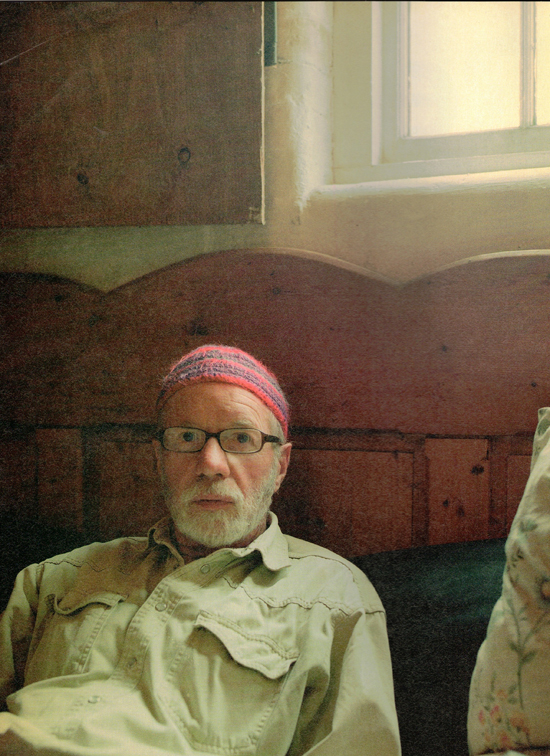
"I've recently taken up ice-skating," Hugh Hopper announces as we settle into a comfortable corner of a cafe in Whitstable, the Kent coastal town that has been his home for the past seven years. Tall, grey-bearded, horn-rim bespectacled and woolly-hatted, his loping appearance doesn't immediately evoke a glide across some frozen lake. Hopper's name remains inextricably linked with Soft Machine in their most creative years, although his last gig with them was way back in 1973. Apart from a brief spell out writing fiction at the the turn of the 1980s he has remained a constantly active musician, performing with such diverse groups as Gong, Japanese percussionist Stomu Yamash'ta's East Wind and and composer Carla Bley's ensemble; pursuing different song projects; and crafting highly idisyncratic soundscapes from loops and samples.
"But Soft Machine set me up as a known person and the name is still being used for groups I play with today - Soft Machine Legacy, Soft Works, Soft Bounds, Polysoft and Soft Mountain," Hopper observes pragmatically. The Legacy group, convened by New York fan Leonardo Pavkovic, features Hopper, saxophonist Elton Dean, drummer John Marshall and initially Allan Holdsworth then John Etheridge on guitar. "We're not slavishly copying tunes, we're doing new pieces so hopefully it's really more than trading on the name," he continues. "But we're getting more work because we're Soft Machine Legacy rather than just the names of the people involved." Hopper's pragmatism might well reflect the lamentable fact that his post-Soft Machine achievements during the past three decades remain under-recognised.
The Legacy project brings together players from different Soft Machine eras. Both Holdsworth and Etheridge belong to post-Hopper line-ups, when the group came to purvey technically polished, musically pedestrian jazz rock. "During the time I was in Soft Machine there was a definite anti-guitar feeling," Hopper recalls, "because every other band in the world had a guitarist." Ironically in 1968 the group - then a trio with Kevin Ayers on bass, Robert Wyatt on drums and Mike Ratledge on keyboards - supported the ultimate guitar group, The Jimi Hendrix Experience, when Hopper was still Soft Machine's roadie. Hopper remembers that early Softs incarnation as a freaky power trio", pointing out that rudimentary rock energy remained a key feature of the group after he replaced Ayers at the end their US tour, they entered the extraordinarily creative phase that produced their finest albums, Volume Two (1969) and Third (1970).
Yet Soft Machine came to acquire a fearsome reputation as cerebral musicians, which was reinforced when, in 1970, composer Tim Souster invited them to perform as a quartet with saxophonist Elton Dean at the Proms. "We played in the late night session with Terry Riley after the main Prom, and were only given 40 minutes or so," Hopper recollects. "We were used to long sets. It was filmed for television under bright lights and that was totally non-conducive to music. But the recording [released in 1988 by Reckless] showed the power of the band live. It was a loud fucking band, it really was. Mike Ratledge on keyboards was playing through two Marshall stacks and so was I, and Robert Wyatt was blasting away on drums. It wasn't a polite, cerebral band by any means," he protests. "The writing was thoughtful but it wasn't presented in a quiet way. You don't actually get that from the studio records, which were a bit dry. The production was always horrendous and usually we went in with new pieces that we hadn't really run in. I was glad that some live archive things started coming out on CD because although the sound is usually awful it shows what the band could do. And for me the feel of the music is more important than the sound quality."
A series of recently issued recordings confirm Hopper's point about the uplifting energetic heft of vintage Soft Machine live. Ratledge received formal musical training and aspired to certain kinds of precision in performance. Dean was a highly accomplished jazz improvisor. But Hopper and Wyatt were largely self-taught, running off another circuit of intuition and musical adventurousness. His own playing was initially fuelled by enthusiasm for Chuck Berry and James Brown. From them he learnt the importance of getting the feeling right, finding the substance and texture to bring musical ideas to life. "Last year, while we were playing a couple of gigs in Paris, Elton Dean said to me, 'I'm really getting into your playing now', and after all these years I thought, 'Oh really!' I was pleased he said it, but surprised. I feel I'm playing more minimally than before. Perhaps that's what he meant - not so many bum notes," Hopper chuckles, adding, "When I listen back to live gigs sometimes, I'm actually amazed that I played that well. I don't consider myself a technician by any means. I'm not being modest, that's just never been my thing. I'm more into supporting and being part of the band."
Hopper's interest in the emotive qualities of sound and rhythm is immediately evident from his longstanding solo pursuit of creating brooding soundscapes from slowly repeating loops. His interest dates back to the mid-1960s when he stayed in Paris with the early Soft Machine's Australian guitarist Daevid Allen, who later founded Gong. Allen's twin awareness of William Burroughs's unorthodox use of tape recorders and Terry Riley's early looped music prompted him to conduct his own experiments with varying lengths of spliced magnetic tape running out into the room and back through the playback head. "I arrived at his flat and had my first ever joint and was hit by this soundscape," Hopper recalls. "It was a Charlie Haden bassline from Ornette Coleman's "Lonely Woman" -the whole thing was based on that. It's stayed in my brain as one of the formative things of my musical life. I still play that motif, it's part of my vocabulary. I can feel it coming out all the time."
Looping has become a commonplace practice that is certainly much less laborious to realise with the advent of digital technology. After witnessing the results of Allen's experiments, Hopper embraced the method at a much messier stage in its development. "It's hypnotic," he explains. "You start a journey and it carries you along. It's like all pulse in music, I suppose - it takes you along with it. It's like my bass playing. My idea of being a bass player is more of a drone thing or a hypnotic thing - definitely a bass and not a treble instrument."
When he was in Soft Machine, the loop provided the group with a practical means of providing music for Peter Dockley's multimedia show Spaced at London's Roundhouse early in 1969. Dockley wanted them to perform live every night. In their place, they provided him with a soundtrack tape resulting from their looping experiments. In 1996 the Spaced recordings were issued as a Cuneiform CD; its atmospheric swirls and layered pulsing have stood the test of time remarkably well. A year before Hopper left Soft Machine, CBS issued his landmark solo record 1984. Two tracks in particular, "Miniluv" and "Miniplenty", displayed his aptitude for imaginative evocation, layering bass, mellophone, percussion, loops and electronics into austere and edgy atmospheres charged with menace. A related piece, "1983", closed Six (1973), Hopper's final recorded flourish with Soft Machine, a sinister and eccentric protrusion from the group's increasingly smooth contours. The experiments he conducted on those tracks somehow inform his 2002 release Jazzloops, on the Norwich based burn-to-order Web label Burning Shed. Fully digitalised and looping gloriously, Hopper works sampled contributions from the likes of Wyatt, Dean and Gong's Didier Malherbe into a highly effective fusion of his moody soundscaping predilections with the glint and gleam of jazz rock improvising.
Hopper's immersion in the physical character of sound is most apparent in the fuzz bass that has become his instrumental signature. Mike Ratledge suggested to him in 1969 that he apply fuzz to bass guitar. "He was using it on organ," he says. "When we were doing Volume Two some of the basslines needed to be equal lines as part of the composition. I've added a flanger now to get a sneaky sound. I've never been a gadget freak. I occasionally get new fuzzboxes. For years I used the same analogue one. When I was playing with Lindsay Cooper on her Oh Moscow project at the start of the 1990s, there was a piece that needed sustain and I bought a digital pedal, which was more reliable but didn't have quite that extreme sound. The fuzz on its own is quite hard to play. Everyone thinks if there's a roaring solo it should be on fuzz but you can only go up the bass to a certain note. Then all you hear is fuzz. You don't hear the notes. It's always much more effective if you've got a quiet area in the music."
|
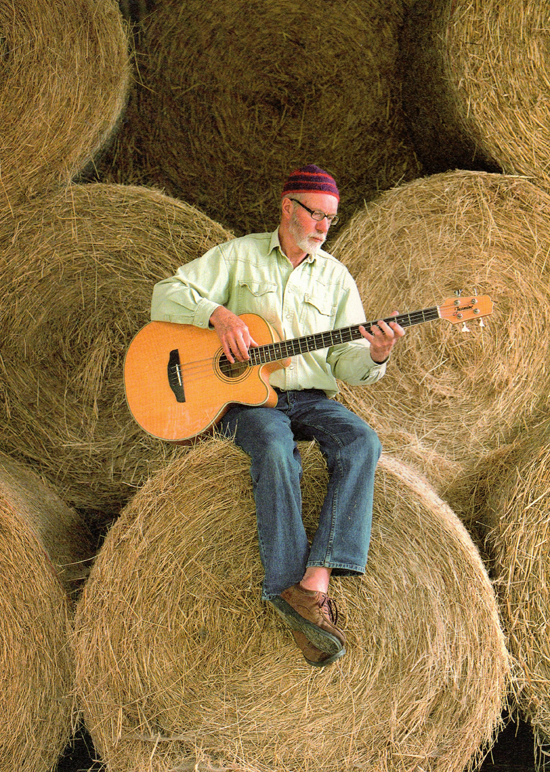
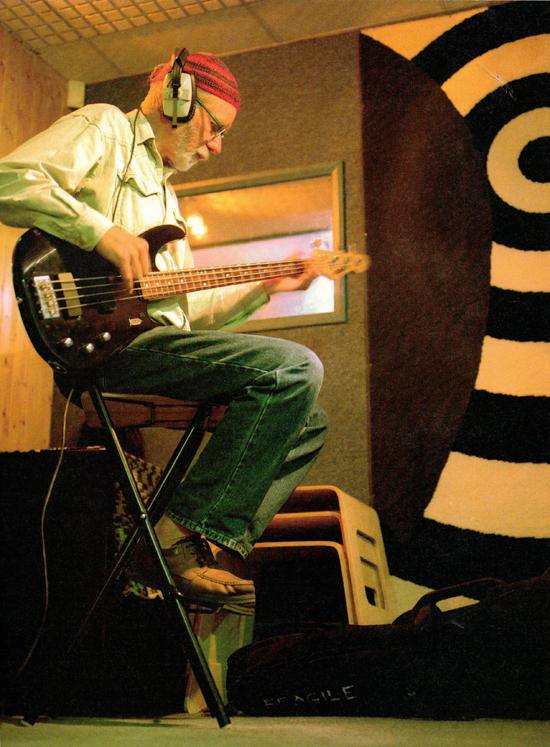
Songs of the baling man: Hugh Hopper photographed at Delta Studios
and in its grounds, near Canterbury, July 2005 |
Hopper's musical character is by now distinctive and firmly established. He acknowledges that over the years there has been little real change in the way he likes to sound. What brings vitality to his music is his openness and curiosity, a willingness to carry that unmistakable bass sound into untested situations. He finds it inconceivable these days that he could be content within the confines of a single group, as he was in those distant Soft Machine days, although playing with Legacy and other Soft variants is a source of real and diverse pleasures for him. "If someone phones me up and says, Do you fancy doing something, I'll always say yes. And then find a way later of getting out of it!" he laughs. "I'll always accept an offer to join a band because I'm inquisitive and interested to know what will happen and I don't want to put up a barrier first of all. Occasionally it works out really well."
In 1996 Mark Kramer, formerly of Shockabilly and Bongwater, paid for Hopper to travel to New Jersey, where they recorded the intriguing Huge (Blueprint). In Hopper's view, the venture succeeded best when he and former Galaxie 500 drummer Damon Krukowski (now of the duo Damon & Naomi) improvised in the studio and then Kramer tweaked and embellished the results with an array of samples and instrumental surfaces. Around the same time Hopper also worked with American group Caveman Shoestore, an offcentre affiliation with accordionist and keyboard player Elaine Di Falco and bassist Fred Chalenor that came to be known in typical punning fashion as Caveman Hughscore.
But it could be argued that Hopper has seeded his most significant post-Soft Machine work while experimenting at home alone and with his computer. He has built up a substantial backlog of usable material playing bass and guitar and sampling any pre-manufactured musical element that might be enhanced with repetition. He has also entered into long distance collaborations through the exchange of audio files. "There's a CD called Unsettled Scores which is people on the Cuneiform label playing each other's music," he says. "I chose a Dr Nerve piece and did a MIDI version. Nick Didkovsky, that group's guitarist, liked it, so as the trio Bone with drummer John Roulat we made Uses Wrist Grab (Cuneiform CD), although we still haven't met. Just email contact." A current long distance project involves multi-instrumentalist David Willey from the group Hamster Theatre. Hopper met him in Seattle, liked his playing, and now contributions are flying back and forth across the Atlantic.
For all the advantages of digital networking, roadwork still accounts for much of Hopper's productivity. On the evening of the day we met, Hopper was driving to London to perform in the group Clear Frame, convened by drummer Charles Hayward with soprano saxophonist Lol Coxhill and multi-instrumental percussionist Orphy Robinson. "There are three or four strands to my musical life," Hopper muses. "The thing I'm doing tonight with Clear Frame, that's completely improvised, no attempt to make any tune at all - the immediate buzz of improvising. Then there's the studio thing, sitting down and doing the minutiae of changing things around - sometimes I just work with building things up from a sound in my computer studio at home. Then there's thinking about music and writing it down on paper or working with a singer. I like all those strands. I don't feel tied down to one thing. The immediate buzz of playing live is completely different from the interesting buzz of sitting in the studio working things out, or sitting with a piece of paper saying, 'That note goes there'."
Hopper is a self-confessed guitar fan who passed through an anti-guitar phase with singular musical outcomes; he is also a writer of fine songs whose anti-song sentiments fortified his commitment to mesmerising SoundScape creations. His songwriting skills first surfaced 36 years ago on Soft Machine's Volume Two. Robert Wyatt's visionary arrangements and singular vocal renditions of words set to Hopper's tunes resulted in a unique music that has lost none of its strangeness and charm. Wyatt's own remarkable "Moon In June" was the only concession to song on the group's Third. The fourth album was entirely instrumental and Wyatt skulked tellingly on the cover, primed for departure. "Robert feels bitter if you mention The Soft Machine because he feels that he was chucked out of his own band," Hopper comments. "In true democratic form we chucked him out. I wasn't interested in the songs at that period. I work with singers now. I actually write music for songs so I've come back to it, but at that time I was totally anti-song because for me to put words to music was to tie it down to one feeling, whereas if you play some soundscape people can have their own fantasy going on. Now I like working with singers, if they've got interesting words."
His most widely recorded song is "Memories", featuring his own lyrics plus a verse penned by Wyatt. Whitney Houston has covered it, guesting with Bill Laswell's Material on their 1982 album, One Down. "I wish she'd done it a few years later," Hopper laughs, "I'd be driving a Maserati! She was unknown then; or known as the daughter of soul singer Cissy Houston. Her version is an exact copy of Robert Wyatt's phrasing from the B side of his single "I'm A Believer". Fred Frith introduced Bill Laswell to Robert's record. She obviously took that home and learned the phrasing. The singer was initially going to be Fontella Bass and I'd always admired her. There's also Archie Shepp on tenor. I thought, hey, fantastic! Actually, he doesn't play very well on it. He plays Archie Shepp but doesn't really fit the tune at all. And Laswell's bass on that is horrendously out of tune. But it was lovely. I'm glad they did it. It's great to say on my CV that Whitney Houston sang one of my songs."
 |
His most artistically successful song projects since the remarkable Wyatt alliance have been his collaborations with vocalist Lisa S Klossner, especially on their fine second release Cryptids (Blueprint 2000). Klossner wrote words, then Hopper wrote music for a small ensemble to play around and beneath them. More recently they reversed their working method, with Hopper sending Klossner soundscapes for her to sing across. The results are very different to the earlier songs. On Cryptids, each track unfolds like a psychodrama of emotional entanglement with Hopper's arrangements setting each scene, lighting it, accentuating mood and disclosing concealed motives. As the Orwellian stimulus behind Hopper's own 1984 suggests, he is especially drawn to narratives that dissolve into uneasy mood and meld with affecting atmosphere. The cinematic impetus of the writing is obvious, and it comes as no surprise when Hopper expresses a desire to compose music for film. He speaks too of his interest in packaging some of his soundscapes on disc to accompany a book. Last year he got together with graphic artist Matt Howarth to produce The Stolen Hour (Burning Shed), where Hopper's disc is augmented with PDF files featuring Howarth's black and white cartoons. Hopper had already been working on the music, laying down bass guitar, funky rhythm loops and samplings of friends singing and blowing, when he invited Howarth to reorganise the track order according to his own narrative ideas.
The sound engineer for Cryptids Julian Whitfield, who runs Delta Studios near Canterbury. Hopper persuaded Whitfield to take the singer's role for their collaboration, In A Dubious Manner (Deliberate). "I'd done some recording at Delta with Lisa Klossner," Hopper recalls. "Also some improvising sessions with Charles Hayward, saxophonist Simon Picard and keyboard player Steve Franklin, which I hope will come out soon. Julian and I fell into doing things together musically because even when it was my project he'd suggest things, and I'd agreed because they were always good ideas. So we realised we were working together anyway. Most of the work on In A Dubious Manner was done by Julian. I provided a lot of raw material and he worked on it in his own studio. It took about two years to finish. He doesn't think of himself as a singer. He'd say, 'Who shall we get to sing it?' And I'd say, ' You've got to'. It's got a nice atmosphere."
The outcome bears Whitfield's stamp, at times displaying his evident taste for Frank Zappa's vocal delivery. In effect it's another instance of Hopper the supportive presence; yet as always when he is involved in a project there's a pervasive Hopper feel, even though he so readily ceded overall control to his collaborator.
Over the years, Hopper has enjoyed fruitful associations with a string of fine guitarists, some of them highly idiosyncratic, including Gary Boyle in Isotope and Phil Miller in In Cahoots. In 2001 he recorded as Glass Cage with drummer Shoji Hano and stereo guitarist Gary Smith. The outcome, released by Paratactile, is spectacular, yet Hopper views his own participation with characteristic critical detachment. "Although I admire what Gary does on an intellectual level, he's one of those people I just don't fall into the same musical slot with," he avers. "He's a very interesting player but it doesn't touch me. It's a good record, but I didn't enjoy doing it. I did it because I was asked to. I was also asked to do a tour with them and I said no, which is unusual for me."
His approach to bass guitar, Hopper says, has been relatively unaffected by close association with such exceptional players, but he acknowledges that working alongside Miller during the mid-1980s made a real difference to his own awareness as a musician and as a writer. "Phil's a great person for harmony and chords," he says, "and it was probably what I was doing anyway, but I suddenly realised harmonically what things were about. Before that I'd write modally without thinking what chord framework works behind it. "Memories" was written on a guitar with chords, but tunes like "Facelift", on Third, I just wrote on the bass as melodic ideas, mostly modal things with a drone. I learnt a lot from Phil about trusting your ears to tell your hands what to do instead of thinking, What shall I play here? You relax, and you've played enough in your musical life to not think about it. You're pretty soon going to hit it. It's already inside you."
Hopper's musical life continues to branch out from its firmly established rootstock. That necessarily involves travel - his home soil offers meagre nourishment these days. He has worked regularly with French musicians since joining ex-Gong drummer Pip Pyle's group Equip' Out in 1984. Saxophonist Pierre-Olivier Govin has been an especially valued associate. His productive liaison with Dutch players began in 1985. The quality of musical education in Holland produces a generally high level of musicianship, he remarks. There are lots of small clubs, and gigs are much easier to arrange than in the UK. When I ask about his following in the USA, he laughs. "Yes they're both still alive," he quips, adding that his records do sell in America but it's becoming increasingly difficult to get a tour together. Japan remains receptive. Indeed, Hopper has recently been editing material from a studio session by Soft Mountain, a project that resulted from a Japanese tour with Elton Dean, John Marshall and Allan Holdsworth in Soft Works. Hopper and Dean joined forces with a pair of local musicians. "There's a great keyboard player called Hoppy Kamiyama, who runs the God Mountain label. I met him when I was over there playing with a version of Gong a few years ago. The drummer was [Ruins'] Tatsuya Yoshida, who has also played with Gong. We sat in the studio for two hours and improvised. It's fairly fierce and all on. Hoppy's great. A serious composer but a complete lunatic - he dresses up as Marilyn Monroe from time to time. As one does." And Hopper grins, still relishing the enchanting strangeness of it all.
Soft Machine Legacy's Live In Zaandam is on Moonjune/Musea; Soft Bounds is on Triton.
 |
|